Dependent Care FSA Receipt for Your Nanny (Free)
Your dependent care FSA plan needs proof of the care from someone other than you, usually the person who gave it: what the care was, the dates, and how much you paid. Your plan's claim form may also ask for the children's names and your nanny's signature.
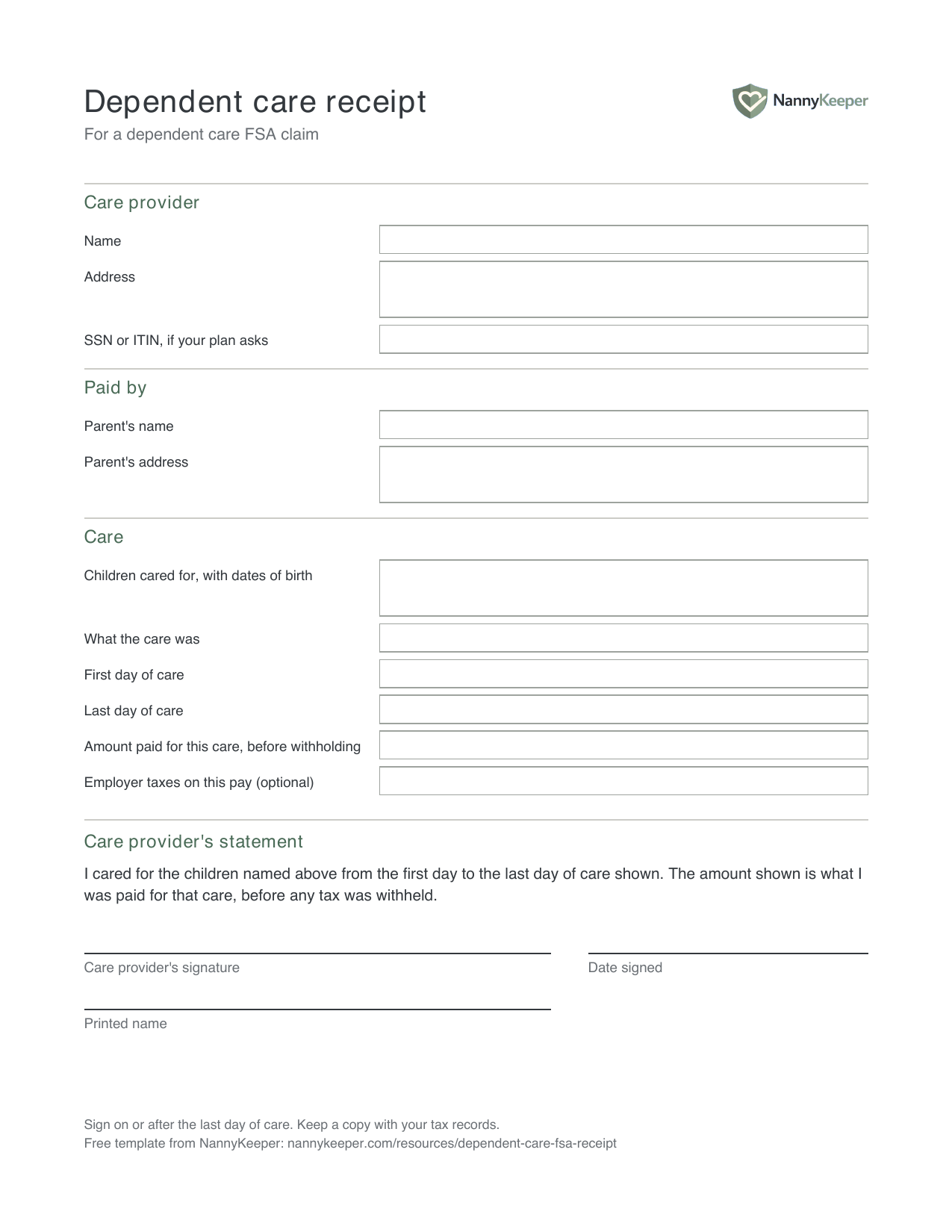
This free receipt has a place for all of it. You can type into the PDF before you print it, then have your nanny sign.
What's on the receipt, and why
A dependent care FSA receipt needs what the care was, its dates and the amount; the rest is there for your Form 2441 or because your plan may ask. Each line below names the rule it answers, or says when no rule asks for it.
| What the rule requires | What your plan may ask for |
|---|---|
| What the care was, its dates and the amount, from someone other than you, your spouse or your dependents (Prop. Treas. Reg. § 1.125-6) | The children's names, and the care provider's signature |
| Your nanny's name, address and SSN or ITIN on your Form 2441 (Form 2441 instructions) | Your name and address, and your nanny's SSN or ITIN on the claim |
Care provider
- Name
- Who gave the care. It goes on Form 2441 too. Form 2441 instructions
- Address
- Form 2441 asks for the provider's address. Form 2441 instructions
- SSN or ITIN, if your plan asks
- Your nanny's number, never your EIN. Give the plan only what its claim form asks for; the full number goes on Form 2441. Form 2441 instructions
Paid by
- Parent's name
- Lets the plan match the receipt to your account. Your plan may ask for it; no tax rule does.
- Parent's address
- Your plan may use it to match the claim to you. Your plan may ask for it; no tax rule does.
Care
- Children cared for, with dates of birth
- The care has to be for your child under 13. Your plan may ask for the names. IRS Publication 503
- What the care was
- The rule asks for a description of the service, such as "child care so I could work". Prop. Treas. Reg. § 1.125-6
- First day of care
- The rule asks for the dates. Care counts when it is given, not when you pay. Prop. Treas. Reg. § 1.125-6
- Last day of care
- A plan can't pay you back for care that hasn't happened yet. Prop. Treas. Reg. § 1.125-6
- Amount paid for this care, before withholding
- The rule asks for the amount. Use gross pay, the figure before any tax was withheld. Prop. Treas. Reg. § 1.125-6
- Employer taxes on this pay (optional)
- The employer taxes you pay on a nanny's wages count as care costs. Your plan may accept them; list them apart. IRS Publication 503
Care provider's statement
I cared for the children named above from the first day to the last day of care shown. The amount shown is what I was paid for that care, before any tax was withheld.
Then a signature, the date signed and a printed name. Your plan may ask for the signature; the rule behind it is that the details come from someone independent of you (Prop. Treas. Reg. § 1.125-6).
Can I pay my nanny with a dependent care FSA?
Yes. A dependent care FSA can pay you back for your nanny's wages when the care is for your child under 13 and it lets you, and your spouse if you're married, work or look for work.
For 2026 you can set aside up to $7,500 a year, or $3,750 if you're married and file separately (IRS Publication 15-B). That's up from $5,000, and your plan can set a lower limit, so check its election form. The tax free amount also can't be more than your earnings or your spouse's, whichever is less.
Two kinds of pay never count: pay to someone you or your spouse can claim as a dependent, and pay to your own child (including a stepchild or foster child) who is under 19 at the end of the year (26 U.S.C. § 129(c)). So a grandparent who cares for your child can be paid from the FSA, as long as you or your spouse can't claim them as a dependent.
The FSA pays you back: you pay your nanny as usual, then send your plan a claim with a receipt for care that has already happened. How the FSA and the childcare credit fit together is in our guide, are nanny taxes deductible.
What receipt does a dependent care FSA need for a nanny?
Your plan needs a description of the care, its dates and the amount, from someone other than you, your spouse or your dependents.
A receipt your nanny signs gives it exactly that. The rule, word for word:
“The independent third-party must provide information describing the service or product, the date of the service or sale, and the amount. Self-substantiation or self-certification of an expense by an employee does not satisfy the substantiation requirements of this paragraph (b).”
That last sentence is why a pay stub on its own can fall short when you are the employer. You made the stub, so it can read as your own record of your own expense. Your nanny's signature on the same figures makes it information from the person who gave the care.
The care also has to have happened first. The same rule counts care as incurred “when the care is provided and not when the employee is formally billed, charged for, or pays for the dependent care,” so a plan won't pay you back for next month in advance.
The employer taxes you pay on your nanny's wages count as care costs too: Publication 503 says “The taxes you pay on wages for qualifying child and dependent care services are work-related expenses.” Your plan may take them on the same receipt, so the template gives them a line of their own.
Do I need my nanny's SSN or ITIN for an FSA claim?
Yes, for your tax return: Form 2441 asks for your nanny's Social Security number or ITIN, and keeping the FSA money tax free depends on it unless you can show you tried hard to get it.
“If the care provider is an individual, enter their SSN or individual taxpayer identification number (ITIN).”
It is your nanny's number, never your EIN. Your EIN identifies you as an employer; the form wants the person who gave the care. Anyone who got dependent care benefits fills in Form 2441, even without claiming the childcare credit.
Your nanny's Form W-4 has the number. You can also ask them to fill in Form W-10, the IRS form made for exactly this. If they won't give it, enter their name and address on Form 2441, write “See Attached Statement” where the number goes, and attach a note saying you asked and they didn't give it. That effort is what lets you keep the tax break (§ 129(e)(9)).
On the receipt itself, give your plan only what its claim form asks for. The full number belongs on Form 2441, and a receipt gets mailed and uploaded.
Does my nanny have to sign the FSA receipt?
Your plan may ask for it: no tax rule requires a signature on the receipt, but the rule wants the details to come from someone other than you, your spouse or your dependents, and your nanny's signature is how the plan sees that.
Have your nanny sign on or after the last day of care on the receipt, since care can't be claimed before it happens. The template's statement reads:
“I cared for the children named above from the first day to the last day of care shown. The amount shown is what I was paid for that care, before any tax was withheld.”
“Before any tax was withheld” matters when your nanny is on payroll. They took home less than the gross amount, and shouldn't be asked to sign that they were handed more than they were. If your plan has its own form for the provider to sign, use it, and send this receipt with it if it helps.
Is a babysitter receipt different from a nanny receipt?
No. A dependent care FSA treats a babysitter and a nanny the same way, so the receipt needs the same things.
That is what the care was, its dates and the amount, from the sitter. The sitter's SSN or ITIN goes on your Form 2441, and your plan's form may ask for it too.
What matters is why you paid. A sitter who watches your child while you work counts. A Saturday date night doesn't, because the care has to let you work or look for work (Publication 503).
A teenage sitter from down the street is fine. Your own child under 19 (a stepchild or foster child included) isn't, even as a paid sitter.
If your sitter works in your home as your employee and you pay them $3,000 or more in cash wages in 2026, Social Security and Medicare apply (Publication 926). A sitter who watches your child in their own home generally isn't your employee, and pay to a sitter under 18 doesn't count unless babysitting is their main job. The babysitter tax calculator shows what you'd owe. More in do I need to pay taxes for my babysitter.
Can I use a dependent care FSA if I pay my nanny under the table?
Not quietly: claiming the FSA means filing Form 2441 with your nanny's name and SSN or ITIN on your own tax return, so the care your plan paid for is on record.
Separately, once you pay a nanny who works in your home as your employee $3,000 or more in cash wages in 2026, you owe Social Security and Medicare tax on those wages and a W-2 for them (Publication 926), whether or not you use the FSA. Claiming the FSA while skipping those puts your nanny on your return without the taxes that go with them.
The way through is to put your nanny on payroll. It's less work than it sounds, and your payroll records fill in the receipt for your nanny to sign. Our guide to switching from paying under the table walks through it.
Written by the NannyKeeper Team. This page explains the rules; it isn't tax advice for your situation, and your plan's own claim rules apply.
Let NannyKeeper fill in the receipt for you
Run payroll with NannyKeeper and the receipt builds itself from the paychecks you ran, with your employer taxes on their own line and a statement for your nanny to sign. You pick the dates and the children, and it downloads as a PDF.
Sign upThe dependent care receipt is part of every paid plan.